DeepGrooveBass: a free Two Notes ReVolt Bass amp sim
v0.3.0 what's new
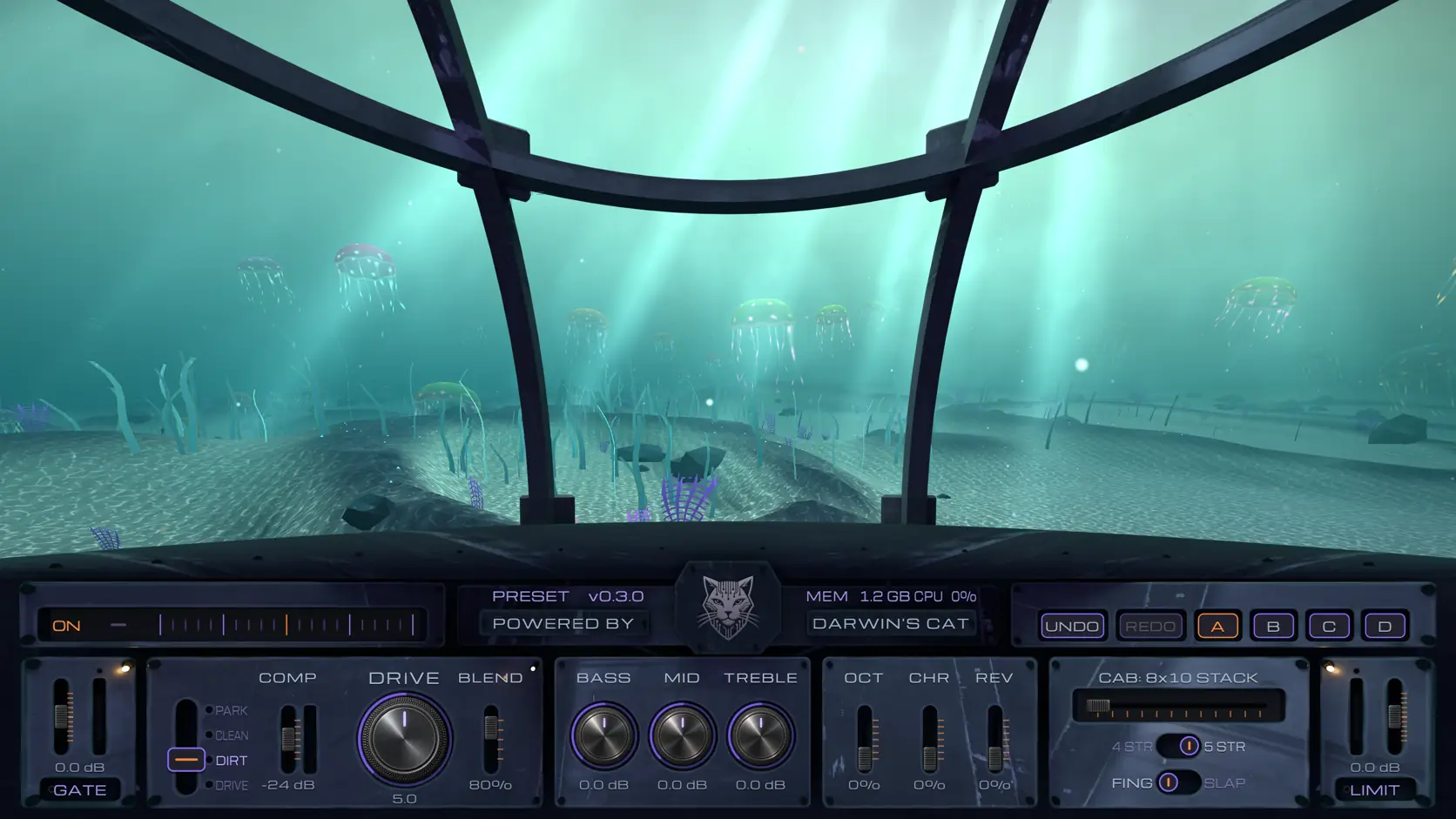
DeepGrooveBass is a free, open-source bass amp: a VST3, AU and CLAP plugin and a standalone app for Windows, macOS and Linux. It has three tube sounds: clean (CLEAN), gritty (DIRT) and overdriven (DRIVE), and all three are genuinely good. It is one of the sounds we, Darwin’s Cat, use ourselves and share. An octaver, a chorus, a reverb and a dozen bass cabinets, from a 1x15 to an 8x10 stack, are built into the plugin and the app. You can listen right here: just press play.
What’s inside
The DeepGrooveBass signal chain: compressor → octaver → preamp → chorus → reverb → cabinet. There are also a gate, a tuner and a limiter.
CLEAN
Channel 1 of the Two Notes ReVolt Bass, Classic Clean: the clean tone in the spirit of channel 1 of the Ampeg SVT '76. Thump, the full frequency range and power: a low end that shakes the rafters, punchy mids and smooth highs. In DeepGrooveBass, CLEAN has BASS and TREBLE and no BLEND: it is clean already. It opens on the 1x15 THUMP cabinet.
DIRT
Channel 2, Vintage Dirt, inspired by the Marshall 1992 JMP Super Bass Mark II: a big bass tone with a coat of vintage dirt, for the moments when the bass has to cut through. Here it has BASS, MID and TREBLE, opens with BLEND at 80/20 and on the 8x10 STACK.
DRIVE
Channel 3, Modern Drive, Two Notes' design: very tight, with plenty of gain for a thick, maxed-out tone. On the pedal this channel has its own dry/wet blend. The captures take it fully wet, and in DeepGrooveBass the BLEND fader does that job with a crossover. It opens at 90/10, on the 8x10 STACK.
You can set the Gain (DRIVE), tone, effects and cabinet separately for each sound. The 4 STR / 5 STR and FING / SLAP switches are shared by all three: switching sounds does not change how many strings the bass has or whether it is played fingerstyle or slap.
On DIRT and DRIVE the BLEND fader can replace the low end with the low end of the clean input signal: this keeps the distortion and gives a powerful, clean low end. The octaver adds a note one octave below the one played, and the chorus leaves the lows alone but adds chorus to the highs.
The cabinet is chosen from the twelve factory presets of Orbit Bass Cab Builder.
The preamp is inspired by the Two Notes ReVolt Bass, a tube preamp pedal with three channels. Its NAM captures can be downloaded.

Two Notes Audio Engineering is a French company from near Montpellier: the Torpedo and Captor load boxes, the DynIR virtual cabinets and the ReVolt tube pedals. It was founded by the guitarist Guillaume Pille, and how it all began is in our article about Two Notes and Guillaume Pille.
Thalassia
Beyond the bathyscaphe’s window is the ocean of the planet LHS 1140 b, which we will call Thalassia. Thalassia orbits a nameless star, LHS 1140, in the constellation Cetus. It is a red dwarf, five times smaller than the Sun and 260 times dimmer. But Thalassia orbits ten times closer to its star than Earth does to the Sun, and it gets enough light and warmth for life to begin.
The star grabbed Thalassia and stopped it. Now one side always faces the star, and the other lies in eternal darkness and cold. Astronomers call Thalassia an eyeball, because it is a huge ball covered in ice, with one warm pupil turned toward the star. Thalassia is an eye that has stared at its nameless sun, LHS 1140, without blinking for billions of years.
There is no ice in Thalassia’s pupil. But only on the surface. The ocean is so deep, and the pressure in the depths so monstrous, that water turns into ice at room temperature. Into an unusual kind of ice. Ice that is heavier than water and sinks. And the whole ocean floor is covered with kilometres of sunken ice. But the planet is not dead: its interior is hot, and under the ice the planet’s crust melts the ice that sank, and the warm water finds its way up through kilometres of heavy, sunken ice and carries minerals to the surface. Carbon dioxide above all. Warmth from the star and carbon dioxide from the depths: this is the very broth that life cooks in. And life is boiling. Our genes once economised and do not keep separate programs for building the left and right halves of our body: the two halves are mirror images with small changes. Here the saving went further: the most advanced animals have radial symmetry, which is even more economical.
Jellyfish rule the pupil. Thalassia is huge, and the pupil is bigger than all of Earth’s oceans combined. There are no continents here to send evolution down separate paths. But here there is the edge of the pupil: the twilight zone. Nobody wants to live near the edge of the pupil, because beyond the edge of the pupil live incomprehensible, cruel creatures. They have no light, and to get energy they have to eat those who live in the light.
The ocean floor of Thalassia is out of reach for life, so coral colonies build huge floating islands (sunk a little below the surface, to avoid touching the hostile air). We are passing over one of the largest of these islands, the size of Sicily. In all, there are tens of thousands of them in the pupil.
Download DeepGrooveBass
| macOS | darwinscat-bass-0.3.0-macos.pkg | 52 MB |
|---|---|---|
| Windows | darwinscat-bass-0.3.0-windows-arm64.zip | 36 MB |
| darwinscat-bass-0.3.0-windows-x64-setup.exe | 19 MB | |
| darwinscat-bass-0.3.0-windows-x64.zip | 39 MB | |
| Linux | darwinscat-bass-0.3.0-linux-arm64.tar.xz | 29 MB |
| darwinscat-bass-0.3.0-linux-x86_64.tar.xz | 37 MB | |
| Checksums | SHA256SUMS | 633 B |
Frequently Asked Questions
Is there a guitar version?
Yes. FrostPawAmp, a rover on Europa, plays the ReVolt Guitar.
What is BLEND for?
So that the bass keeps a clean low end under the overdrive. Above the crossover frequency it is always the preamp that plays: the growl and the top end stay. Below it, BLEND mixes the preamp with the clean input: at 100% only the preamp, at 0% only the clean input. The plugin itself matches the clean part, in delay and in phase, to the part that has gone through the amp. The crossover frequency, from 80 to 250 Hz, is picked with a right-click on BLEND (not in the web version). DIRT opens at 80/20, DRIVE at 90/10, and CLEAN has no BLEND.
What is the compressor for?
A bass sounds uneven: a finger pluck, a slap and a muted note all come out at different volumes. The compressor evens this out: it brings up what is quiet, holds back what is loud, and the bass sits evenly under the drums. This one is optical and soft, with a 4:1 ratio. Three quarters of the signal go through it, and a quarter goes past it (parallel compression), so that the attack is not lost. It has one fader, the threshold: the higher the fader, the harder it compresses. The bar next to it shows how many decibels it is taking off right now.
Why doesn’t everything work in the web version?
The web version is heavily simplified. In the DeepGrooveBass cockpit, in the plugin and the app, there is more of everything. And the most complete ones are OrbitBass and OrbitAmp.
Can I use your NAM captures and IRs in music, software and hardware?
Yes.
- Play, record, perform and sell music made with them: freely, no conditions.
- Share the files, including posting them on websites: with credit to Darwin's Cat.
- Build them into software or a device: if it is free itself, its source open under the GPL or AGPL, with credit to Darwin's Cat. Into a closed product only with our written permission.
Telling us where you used our NAM captures or IRs is optional, but we will be grateful for an email to band@darwinscat.com.
Which DAWs does DeepGrooveBass work in?
Any that opens VST3, CLAP or AU. Logic Pro and GarageBand use AU (macOS only); Ableton Live, Cubase, Reaper, Bitwig and Studio One use VST3; Reaper and Bitwig also CLAP. On Linux, VST3 and CLAP. Without a DAW, the standalone app works.
Is DeepGrooveBass really free? What does AGPL mean?
Yes, completely free: no sign-up, no keys, no ads. The AGPL is a free license: the source code is open to everyone. Music recorded with DeepGrooveBass belongs to its author, commercial use included. Anyone who distributes a modified version of the program itself must open its code too.
Does DeepGrooveBass track me?
No. DeepGrooveBass goes online in two cases only. If you switch on the update check, it asks GitHub whether a new version is out: GitHub sees the IP address, the program's name and its version, nothing more. And if you click the cat on the panel, our website opens in your browser; it runs without cookies and without third-party trackers.
Why do you do this? Working for free is immoral by the logic of capitalism. Are you communists?
No, we are not communists. But we know that altruism is one of the most powerful weapons evolution ever invented. Not teeth, claws and poison spines, but altruism. We sing about it in our songs, for example in Eleven Light Years.
Is DeepGrooveBass connected to Two Notes?
No. Two Notes and ReVolt, Ampeg and SVT, Marshall and Super Bass are trademarks of their owners. We name them only to say what inspired the preamp. The cabinets in DeepGrooveBass are ours.
What about the logos?
In the download table, macOS has a pear scratched by a cat, and Windows has a window scratched by a cat, its tile falling off. We don't love Microsoft and Apple, if only because they make developers pay for the right to distribute their programs on their platforms, and on principle we don't use their logos. These logos are ours, and you can use them: the pear and the window as SVG.